Posts

Image
היום הצגנו את הפרזנטציה והדמו של הפרויקט והבחנו שיש דברים שעלינו להוסיף ולחדד כמו לדוגמא העקרונות עיצוב. ביום רביעי הקרוב 30/5 אנו נציג את הפרויקט הסופי. עד ה13.06 אנו עובדים על הסרטון תדמית.
Image
11/3 In the past weeks we examined many objects and devices to find the perfect motion for our prototype. We thought about nature, animal gestures. A motion that will be cute, intuitive, not annoying. We went with a "move away" gesture. The movement itself will probably happen on some sort of wheels. Our first lego version looked like this:
After a long break, we are starting to get ready towards the end of the year. The technical part of the team is working on the final prototype with an industrial designer while the rest organize the pitch presentation, a video and media we have collected throughout the year.
After presenting our research work we concluded we must be more specific with our solution. Our first target was to help students maintain attentiveness during class, but now we ask ourselves do students really want to be focused in class? and if they do, how much are they willing to sacrifice to achieve it
Image
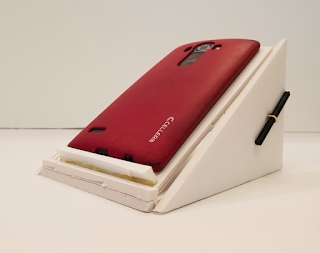
Experiencing with more mechanisms. We wanted to test how does it feel when the phone falls and bounces on different kinds of materials.
Image
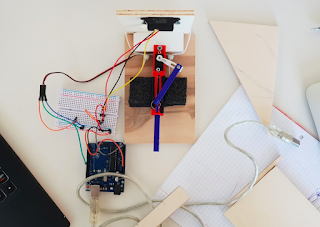
We met with Tal Makers who has an institute for teaching kids arduino and electricity. We discussed  possible implementations for out prototype. Below is one of the mechanisms we have tried - a servo motor that operates an arm, providing a linear movement.
25/2 A new question came up - why physical and not an app? We could make an app that tracks your phone usage and prevent the user from using it. We've checked existing apps in the market and all of them did not succeed. We believe that the main reason is that the target is to disconnect the user from the phone, which isn't possible with an app because IN the phone itself. We decided to physically detach the user from his phone.
Image
Our tests have shown an increase of 50% in levels of attention with the object, compared to without the object. Those are great news, but another problem arose- the object's motion is annoying and doesn't make the users want to use it again. In the upcoming weeks we will research motion and figure out which motion suits us best.
During the last week we asked students weather they feel like they are attentive during lectures, and if they are satisfied with the current situation. Reviewing the results, most students indicated that they cannot maintain full attentiveness during class and would like to use a device that will help them. This is a strong conclusion for us since it validates our need.
In the past two weeks we reviewed all the in class distractions and decided to focus on the main attention monster - the smartphone. Our research has shown that students want to be able to put their phone aside so that they can focus on the lecture. It has been decided that the problem we are trying to solve the students smartphones that are trying to steal their attention constantly.
Image
Our computer science part of the team Eyal and Roni have made our first prototype for A/B testing. The student puts it in front of him on the table and once the student loses his attention (spotted by a tester of our team) the arm starts to move back and forth, as if asking him to stay focused. The only way to make the arm stop moving is to press the button- some sort of "contract" between the object and the user. Let's begin with A/B testing
In the last 2 weeks we continued our user testing; we asked students in class to draw a line every time they felt they have lost attention to the lecture. At the same time, a person from our team has  observed the student as well. The students answered questions at the end of each test. We have learned that just by the fact that students were asked to mark each time they lose attention, they were more attentive during the lecture.
14/12 At this point we are focusing on our feedback the object will output. It can be a negative-punishing feedback or a positive feedback. Studies show that negative feedback does not work most times, therefore we have decided that our object will be some sort of trainer for attentiveness. Now we proceed to building our first prototype!
We have defined our need- maintaining classroom attentiveness throughout a lecture. Weeks 2 and 3 were dedicated to research work and interviews. We have interviewed students and professors from different fields of study, in the hopes of noticing common behaviors leading to classroom distraction and techniques to maintain attentiveness. The majority of the interviewees are aware of their low attentiveness levels and wish to improve it. Our competitive analysis showed different aspects of the problem and various solutions. Most solutions are problematic. Some require high cognitive load, some require too much engagement. Some are too restrictive, and some simply do not work. On Sunday 18/11 we are presenting our research work to the lab. First, we present our need and why we think it is necessary. Then, we will show our validation process and competitive analysis in more detail, and at last- our vision. To help every student who is motivated to improve his classro...

Hello world!

This is the beginning of our journey. Five students from three different schools in IDC brought together under IDC's miLAB to create a new product to hopefully implement in a smart campus environment. This blog will document our process we are about to undergo. Our team is composed out of two Computer Science students, two Communications students and one Psychology student. During the upcoming year we will study, research and experiment such that by the end of the year we will have a viable physical prototype which makes a difference no matter how small (or big) in students day-to-day life. Stay tuned! Eyal, Roni, Shachar, Einat & Oren.